
Just so you know: some links in this post are affiliate links. If you book through them, I may earn a small commission at no extra cost to you. I only link to things I’d tell a friend to use.
Iceland campervan parking is the first thing to sort out when you rent a van, and the honest answer isn’t the one they hope for. You can’t just pull over somewhere pretty and sleep. Since 2015 you’ve needed a campsite, or the landowner’s permission, and in most of South Iceland even that isn’t enough along the road. Here’s what the law actually says, what you get fined, what campsites really cost in 2026, and where to empty the toilet.
I’m Icelandic, I’ve lived here my whole life and I’ve worked in tourism for almost 20 years. “Free camping in Iceland” went from normal to banned, and a lot of blogs and rental sites still haven’t caught up on Iceland campervan parking.
The quick version
Sleep at a campsite. Outside towns, the law says you need the landowner’s permission to use a campervan anywhere other than an organised campsite. Inside towns, and along public roads in inhabited areas across the whole South, local bylaws ban overnight stays outside campsites altogether. Fines start at 30,000 ISK. A couple pays roughly 4,400 ISK a night at a typical rural campsite, or about 7,300 ISK in Reykjavík (October 2026).
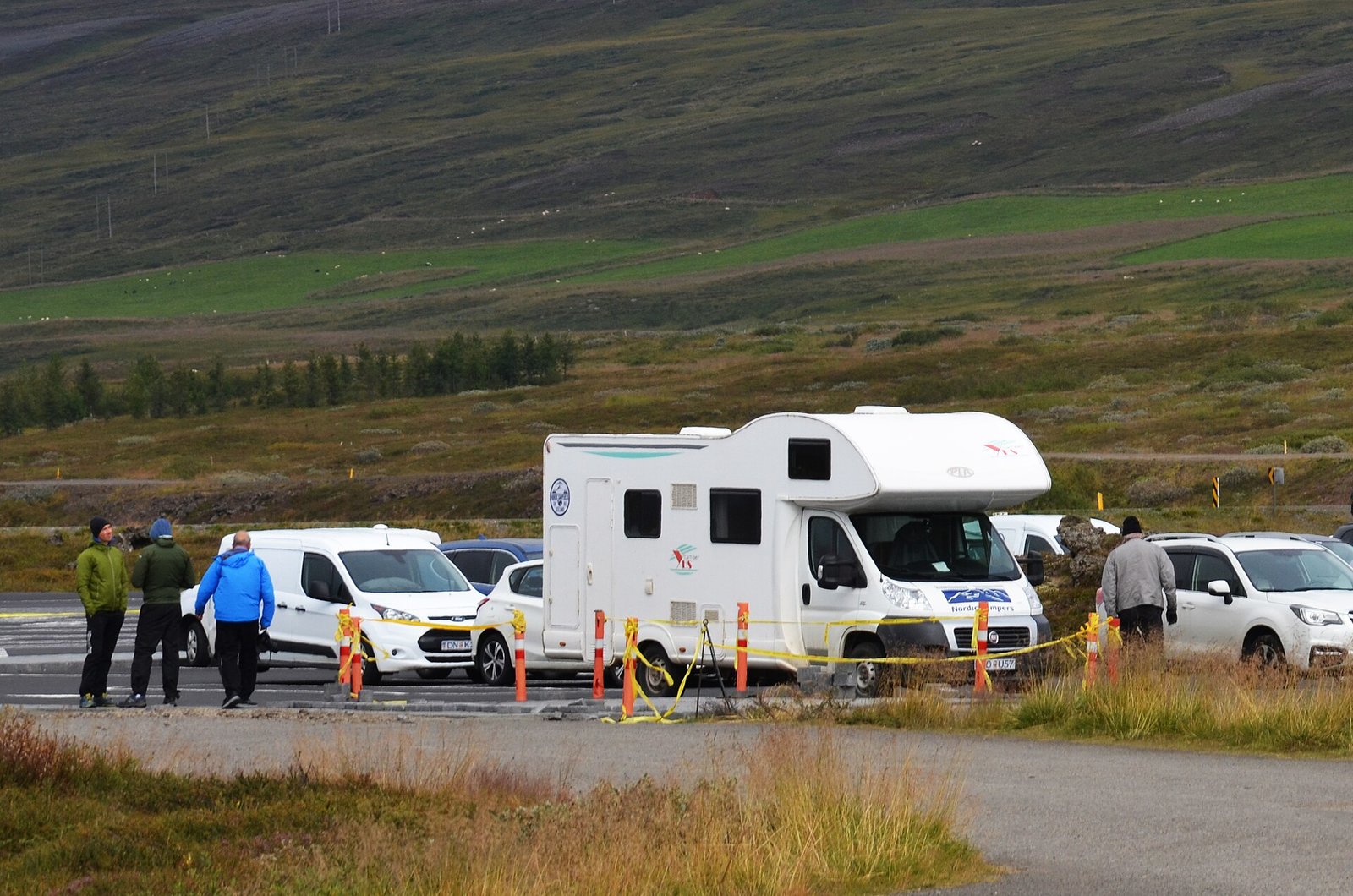
Iceland Campervan Parking: The Short Answer
You can park a campervan almost anywhere a normal car can park. You can stop for a coffee, a walk or a short rest. What you can’t do is stay the night wherever you like.
For overnight stays, you have two legal options:
- An organised campsite. This is the answer 99% of the time. There are campsites in almost every village, and many farms run small ones too.
- Private land, with the owner’s permission. This only works away from public roads, and in practice it’s rare. A farmer saying “sure, park by the barn” is fine. A car park with no sign saying you can’t isn’t permission.
There’s no list of official free overnight car parks in Iceland. If an app or blog shows you one, read the rest of this post before you trust it.
What the Law Says About Iceland Campervan Parking (Changed in 2015)
The rules are in the Nature Conservation Act, no. 60/2013, article 22. Two parts matter for you:
- Tents: along public routes in inhabited areas, you may pitch a traditional tent for one night on uncultivated land, if there’s no campsite nearby. Near houses, for more than three tents, or for more than one night, you ask the landowner first.
- Campervans, motorhomes, caravans, folding campers and tent trailers: outside urban areas, you need the landowner’s or rights-holder’s permission to use them outside organised campsites. This was added in November 2015, and it’s the reason the old “sleep anywhere” advice is dead.
Note what the law doesn’t say. It doesn’t make an exception for “self-contained” vans with a toilet, and there’s no “three-hour rest” rule. A toilet on board is useful. It doesn’t change where you’re allowed to sleep.
Article 23 also lets a landowner send you to a campsite and charge for it, and article 31 lets you pull your car over beside the road if it doesn’t damage anything or put anyone in danger. That’s parking, though, not camping.
Towns, and the whole South Coast
Towns are covered by police bylaws. The national model bylaw (regulation 1127/2007, article 10) says you may not sleep in tents, motorhomes, caravans or tent trailers in public places in urban areas, except in specially marked areas. Reykjavík’s own bylaw says the same.
Then there’s the joint police bylaw for South Iceland, in force since November 2017. Its article 12 bans overnight stays in tents, motorhomes, caravans, folding campers and similar along public routes in inhabited areas, outside organised campsites. No mention of landowner permission.
It covers 14 municipalities, from Ölfus and Hveragerði all the way east to Hornafjörður. That means the whole Golden Circle, the whole South Coast, Vík and Höfn. The Reykjanes peninsula (where the airport is) and North-West Iceland have the same wording in their bylaws.
So on the classic first-timer route, your realistic choice is campsite or campsite.
Protected areas are stricter still
The nature agency’s official “where can you camp” page lists places with their own rules. A few on popular routes:
- Skógafoss: overnight stays only at the Skógar campsite.
- Vatnajökull National Park (Skaftafell, Jökulsárlón area): vehicles must use the organised campsites.
- Dyrhólaey: you need a permit.
- Mývatn: marked campsites only. At Dimmuborgir and Hverfjall, no camping or overnight stays at all.
- Dynjandi in the Westfjords and the Arnarstapi–Hellnar coast on Snæfellsnes: no overnight stays.

What Happens If You Sleep Somewhere You Shouldn’t
You’ll read “fines start at 50,000 ISK” on rental sites. I couldn’t find that number in any official source. Here’s what I did find.
The State Prosecutor’s fines instructions (RS 1/2025) say a breach of a police bylaw is fined according to how serious it is, with a minimum of 30,000 ISK. The ceiling for police fines is 1,000,000 ISK. Breaking the Nature Conservation Act is a separate offence, and it can also be fined.
If you’re in a rental, the fine usually lands on the rental company first, because the van is in their name. They’ll charge it to your card, often with an admin fee on top. Read your rental terms for the exact fee.
Compare that with a campsite at around 4,400 ISK a night for two. Sleeping in a lay-by to save money is the most expensive Iceland campervan parking mistake you can make.
What Campsites Cost in 2026
Prices are set by each campsite, usually per adult, with kids often free or cheap. Here are real examples:
- Reykjavík Campsite (Laugardalur): a campervan pitch is 3,555–3,735 ISK including one adult, or 5,715 ISK with electricity. Each extra adult is 3,150 ISK, and kids 12 and under are free. Those are the online prices on its price page (October 2026). One section stays open all winter.
- Rural campsites: most charge somewhere between about 1,100 and 2,200 ISK per adult. Skógar is 2,100 ISK per adult (October 2026).
- Lodging tax: on top of that, you pay 400 ISK per camping unit (your van) per night.
- Extras: showers, electricity and the washing machine usually cost extra. Expect a few hundred krónur for a shower, and 1,000 ISK or more for electricity.
So for two adults in one van, a typical night is about 2 × 2,000 + 400 = 4,400 ISK in the countryside. In Reykjavík it’s about 3,735 + 3,150 + 400 = 7,285 ISK, without electricity (October 2026).
Most rural campsites are first come, first served, so you just turn up. In winter many are closed, so check opening dates before you drive somewhere at 21:00 in November.
A local tip: if your campsite’s showers are cold or coin-operated, go to the nearest town pool instead. Around 1,500 ISK gets you a hot shower, hot tubs and a swim (Reykjavík pools, October 2026). Pools are what Icelanders actually use, and I’ve written about the best ones in the hot springs locals actually visit.
Is the Camping Card (Útilegukortið) Worth It?
The Camping Card, Útilegukortið in Icelandic, cost 24,900 ISK (or €179) for 2026. It covers two adults and up to four children under 16, for up to 28 nights at participating campsites. It’s valid until 15 September.
The catch is the list. In 2026 it was accepted at 30 campsites, and you’ll still see “over 40” quoted in places. There’s none in Reykjavík. In the South you get Laugarvatn, Stokkseyri, Þorlákshöfn, Kirkjubæjarklaustur (Kleifarmörk), Skjól, Faxi and the airport campsite at Sandgerði. Most of the rest are in the north, east and Westfjords.
It covers the pitch only. You still pay the 400 ISK lodging tax and any showers or electricity.
Rough maths: at around 2,000 ISK per adult, a couple needs about 7 nights at card campsites to break even. If you’re doing two or three weeks around the Ring Road, look at the map and count. If it’s a week on the Golden Circle and South Coast, you probably won’t get there. The 2027 price and list weren’t out yet when I wrote this, so check both before you buy.
What I’d book
A campervan only if you’re happy paying for campsites
Add 4,000–7,500 ISK a night for two to the van price, then compare it with a small car plus guesthouses. I compare local companies on Localrent.
Campervan Apps: Parka Yes, Park4Night With Care
Parka is the parking app most Icelanders use. You’ll want it anyway for paid parking at sights and in towns, which is a whole post of its own. It also runs Parka Camping, where you can book some campsites ahead, and the campsite directory Tjalda.is. That’s a handy private directory with prices and facilities, but it isn’t an official government list.
Park4Night is where I’d be careful. Anyone can add a spot, and plenty of the Iceland pins are car parks, viewpoints and gravel pull-outs where sleeping overnight is now illegal. Comments like “stayed here, no problem” just mean nobody came by that night. Use it to find campsites and dump stations. Don’t use it as proof that a free spot is allowed.
All of these apps need mobile data. An eSIM like Yesim sorts that out before you land.
Where to Empty Your Campervan Toilet
Toilet waste may only be emptied at designated disposal points. That’s the agency’s rule, and it’s also just decency. Not in a petrol station toilet, not in a ditch, and never rinse the cassette with a fresh-water hose.
- Most campsites have a disposal point. Ask at reception.
- In the capital area there are public stations at Klettagarðar in Reykjavík and Hraunavík in Hafnarfjörður.
- Elsewhere, use the official map of disposal points from Umhverfis- og orkustofnun. It includes campsites and some fuel stations.
Keep kitchen and shower water separate from toilet waste where you can, and empty that at the campsite too, not onto the ground.

How I’d Plan Campervan Nights on the South Coast
The simplest Iceland campervan parking plan: book or pick the campsites first, then fit the sights around them. On the South Coast, good stops are Skógar for Skógafoss, Vík, Kirkjubæjarklaustur and Skaftafell. For quieter campsites Icelanders actually choose, see the best campsites in Iceland. Check how long each leg really takes in how long the South Coast drive takes.
Don’t try to squeeze in an extra hour of driving at the end of the day just to save a campsite fee. Tired late-night driving is on my list of Iceland road trip mistakes for a reason.
Planning South Iceland yourself? Don’t overpay on the way.
My free guide: 10 things tourists waste money on in Iceland, and what locals do instead. Prices checked October 2026.
Iceland Campervan Parking: FAQ
Can you sleep in a campervan anywhere in Iceland?
No. Since November 2015, outside towns you need the landowner’s permission to use a campervan outside an organised campsite. In towns, and along public roads in inhabited areas in South Iceland, Reykjanes and North-West Iceland, overnight stays outside campsites are banned outright.
Is wild camping legal in Iceland?
Only in a tent, and only within limits. Along public routes in inhabited areas you can pitch a traditional tent for one night on uncultivated land if no campsite is nearby. In vans and motorhomes, no.
Can a self-contained campervan park overnight for free?
No. The law doesn’t care whether your van has a toilet. The same rules apply to every campervan, motorhome and caravan.
How much is the fine for illegal camping in Iceland?
A police-bylaw breach is fined at a minimum of 30,000 ISK, based on how serious it is (RS 1/2025). A rental company will usually add its own admin fee when it passes the fine on.
Can I stop at a rest area to sleep for a bit?
Stopping to rest when you’re tired is always the right call, and parking safely off the road is allowed. Staying the night there isn’t. If you’re that tired, drive to the nearest campsite.
Are campsites open in winter?
Some are, and Iceland campervan parking gets harder in winter. Reykjavík Campsite keeps one section open all winter, but many rural sites close from autumn to spring. Check before you set off.