
Just so you know: a couple of links in this post are affiliate links. If you book through them, I may earn a small commission at no extra cost to you. I only link to things I’d tell a friend to use.
Every summer I see the same scene at a quiet countryside petrol station: a rental car at the pump, a tourist pressing the same card into the machine for the third time, and a growing look of panic. Knowing how to pay for gas in Iceland before you land saves you that moment, and sometimes a lot more than a moment.
Most stations here have no staff at the pump, and many in the countryside have no staff at all after the shop closes. The machine wants a card and a PIN, and it doesn’t care that you’re tired and 80 km from the next town. So here’s how it actually works, what it costs, and the tricks locals use. Prices checked October 2026.
The quick version
Bring a card with a 4-digit PIN. Pick a fixed amount at the pump instead of “full tank” to avoid a big hold on your card. Buy a prepaid fuel card in town as a backup. Orkan and Atlantsolía are usually the cheapest, N1 and Olís the dearest. Petrol is about 255–290 ISK a litre and diesel about 310–340. Never let the tank drop below half outside the capital area.
1. Your card needs a PIN
This is the big one. Almost every pump in Iceland is self-service, and the payment terminal asks for a 4-digit PIN. No PIN, no fuel.
Most European cards are fine. The problem is mainly cards from the US and a few other countries that are set up for signature, not PIN. Some will work, some won’t, and you really don’t want to find out at 10 pm in the East Fjords.
Before you fly:
- Check that you know the PIN for every card you bring, credit and debit
- If your bank can’t give you a PIN, ask for one of their cards that has one, or bring a debit card that does
- Tell your bank you’re travelling, so the first payment in Iceland doesn’t get blocked
Contactless and phone payments now work at plenty of pumps in and around Reykjavík. Out in the countryside I wouldn’t count on it. Treat Apple Pay and Google Pay as a bonus, not a plan.
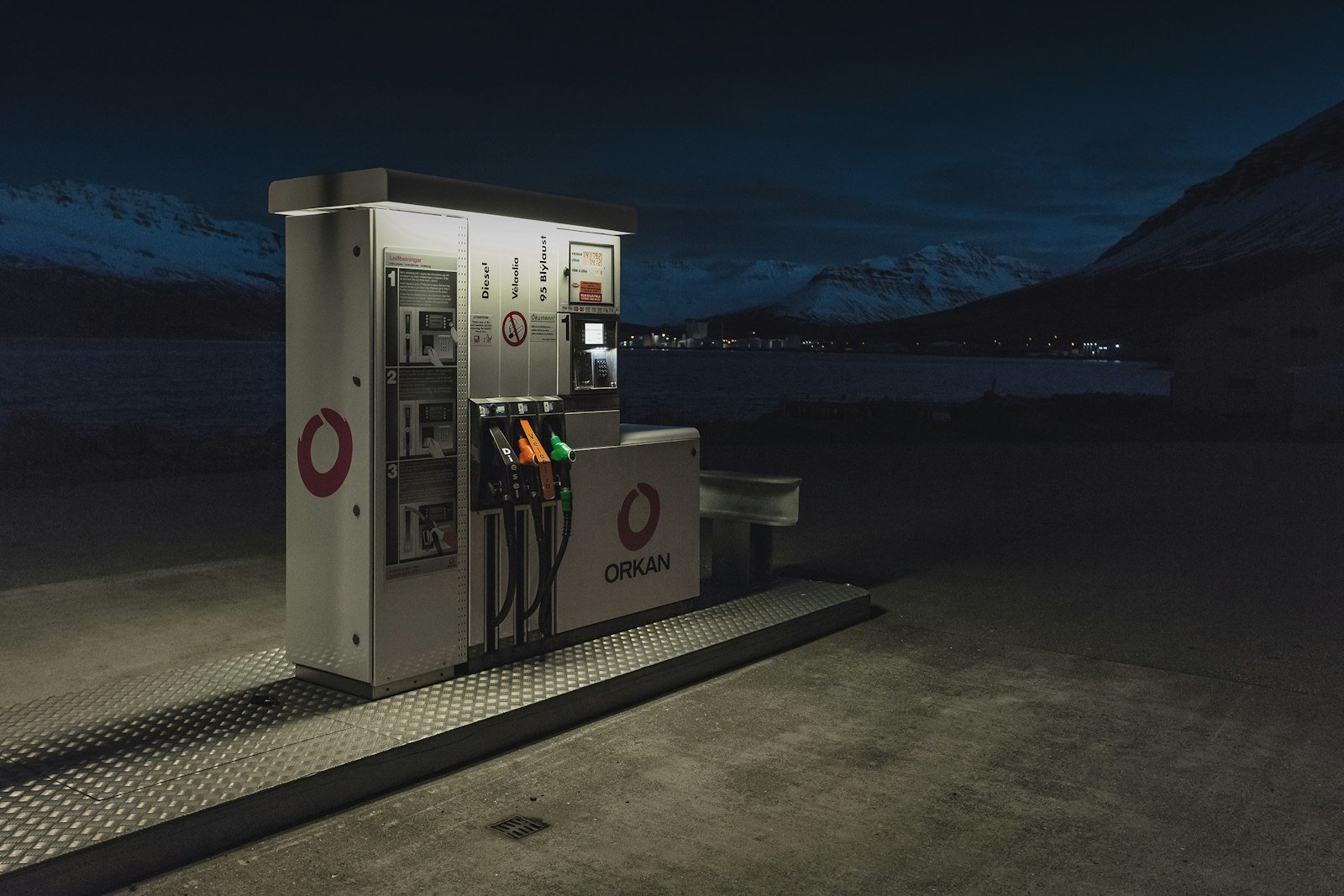
2. How to pay for gas in Iceland at the pump, step by step
The machines look slightly different at each chain, but the order is almost always the same:
- Pick your language. There’s an English option (often a little flag) on the first screen.
- Insert your card and type your PIN.
- Choose an amount. You’ll see buttons like 5,000, 10,000 and “full tank” (or “Fylla”). More on why I’d pick a number in a moment.
- Choose your pump number. At many stations one terminal serves several pumps, so check the number painted on the pump next to your car.
- Fill up. Petrol is marked Bensín (95 octane) and diesel is Dísel. The pump stops on its own at your chosen amount.
- Get a receipt if you want one. Go back to the terminal and look for Kvittun, which means receipt.
You’re only charged for what you actually pump. If you chose 10,000 ISK and the tank was full at 7,400, you pay 7,400.
Local tip: Check the sticker inside the fuel flap before you lift the nozzle. Putting petrol in a diesel rental is one of the most expensive mistakes you can make on an Iceland trip, and rental insurance usually doesn’t cover it.
3. Watch out for the hold on your card
This is the part of how to pay for gas in Iceland that nobody mentions. When you press “full tank”, the pump doesn’t know how much you’ll take, so it reserves a large amount on your card first. Travellers report holds of around 20,000 to 30,000 ISK, depending on the chain.
The unused part is released, but your bank decides how fast. It’s usually a few working days. On a card with a low limit, three or four “full tank” fill-ups in a week can leave you with less spending room than you expected.
How to avoid it: choose a fixed amount instead. A small rental car takes roughly 14,000 ISK from nearly empty to full at October 2026 prices, so 10,000 ISK is a sensible default if you fill up at half a tank, which you should (see number 6).
4. Prepaid fuel cards are your backup plan
If you’re not sure your card will work, or you just want a plan B, buy a prepaid fuel card. N1 sells them at its staffed stations, in fixed amounts, and you use them at the pump just like a bank card.
A few things to know:
- Buy it in a town during opening hours. You can’t buy one from an unstaffed pump at night, which is exactly when you’ll need it
- It only works at the chain that sold it, so an N1 card means N1 stations
- Any balance left over isn’t refunded, so don’t load more than you’ll use
Locals don’t bother with these. We use a key fob or app from our usual chain, which gives a few krónur off per litre. Those discounts need an Icelandic ID number, so for a visitor the prepaid card is the closest thing.
5. Which chain is cheapest? October 2026 prices
Iceland has five main fuel chains, and the price gap between them is bigger than most people expect. Here’s what the capital area looked like on 21 October 2026 (self-service, per litre, no loyalty discount):
- Orkan: petrol from 254 ISK, diesel from 310 ISK
- Atlantsolía: petrol from 255 ISK, diesel from 310 ISK
- ÓB: petrol from 255 ISK, diesel from 310 ISK
- N1: petrol 255–287 ISK, diesel 313–338 ISK
- Olís: petrol about 287 ISK, diesel about 336 ISK
Across the whole country the average is roughly 280 ISK for petrol and 330 ISK for diesel. Out in the countryside you’ll often have one station and one price, so take it.
The cheapest fuel in Iceland is at Costco in Garðabær, but you need a Costco membership card to use the pumps. For most visitors it’s not worth the detour.
Prices move every few days. Before a long drive, check GSMbensín, which lists today’s price at every station in Iceland.

6. Fill up more often than you think you need to
Around Reykjavík and along the Golden Circle, there’s a station every few kilometres. Out east and up north, that changes fast. The Route 1 stretch across Möðrudalsöræfi, between Egilsstaðir and Mývatn, has next to nothing for well over 100 km.
My rule, and most Icelanders’ rule: never let the tank drop below half outside the capital area. If you pass a station and you’re near half, stop. A tow out there starts at around 40,000 ISK, and that’s before the wait. Running low on fuel made my list of the 10 Iceland road trip mistakes I see most often, and for good reason.
Small-town stations are also where you’ll find toilets, hot coffee and a hot dog, so the stop is rarely wasted. Just remember that the shop may close at 8 or 9 pm while the pumps run all night. That’s another reason to sort your card or prepaid card out in daylight.
7. Know your rental car’s fuel rules and the kilometre tax
Two things on your rental contract affect what you pay for driving, and both are easy to miss at the desk.
The fuel policy. Most companies hand you the car full and expect it back full. If it isn’t, they refuel it for you, usually at a price well above the pump plus a service fee. Fill up at the last station before the airport. There are several along the road to Keflavík.
The kilometre tax. Since 1 January 2026, every car in Iceland pays a kilometre-based road tax, which replaced most of the old fuel tax. That’s partly why fuel is cheaper than it was a couple of years ago. For a normal car it’s 6.95 ISK per kilometre, or the rental company can charge a flat daily fee instead. The official daily rate is 1,390 ISK, and some companies add their own fee on top. The rules are on Ísland.is, the government’s official site.
A full Ring Road at the per-kilometre rate adds about 9,300 ISK to your trip. Ask at pickup which model your company uses, because it changes which one is cheaper for your route.
What I’d compare
Fuel policy and kilometre tax, side by side
Localrent lists the local Icelandic rental companies with what each price includes, so you can see the fuel and tax terms before you book.
Fuel is only one of the costs. Here are the other nine.
My free guide: 10 things tourists waste money on in Iceland, and what locals do instead. Prices checked October 2026.
FAQ: paying for gas in Iceland
Can I pay for gas in Iceland with cash?
Only inside a staffed station while the shop is open, and even then many people never see cash. The pumps themselves take cards only.
Do the pumps work 24 hours?
Yes, almost all self-service pumps work around the clock. The shops don’t, so buy prepaid cards and snacks during the day.
Will my phone work at the pump?
Often in and around Reykjavík, less often in the countryside. Bring a physical card with a PIN as your main option.
How much does a full tank cost in Iceland?
A small rental car is about 14,000 ISK from nearly empty at October 2026 prices. A large 4×4 on diesel can be 20,000 ISK or more.
What if my card is refused?
Try a different card, then try a fixed amount instead of “full tank”. If nothing works and the shop is closed, the next staffed station is your only option, which is exactly why the half-tank rule exists.
The short answer
So, how to pay for gas in Iceland without the stress? A card with a PIN, a fixed amount instead of “full tank”, a prepaid card in the glovebox for back-up, and a half-full tank whenever you leave a town. Do those four things and the pump becomes the least interesting part of your road trip, which is exactly how it should be.