
Just so you know: some links in this post are affiliate links. If you book through them, I may earn a small commission at no extra cost to you. I only link to things I’d tell a friend to use.
The Snæfellsnes fishing villages are the part of the peninsula most people drive straight through. That’s a shame, because they’re what makes a day out here feel like Iceland rather than a list of photo stops. Snæfellsnes gets called “Iceland in miniature”: glacier, lava, black beaches and sea cliffs on a peninsula about 90 km long. But between the big sights there are small harbours where people still fish for a living, and a couple of towns that are worth an hour of anyone’s time. Here are the six Snæfellsnes fishing villages I’d stop in, going clockwise from Reykjavík, with 2026 prices and the things that have changed.
The quick version
Going clockwise round the Snæfellsnes fishing villages, stop at Arnarstapi and Hellnar for the cliff walk, Hellissandur for murals and the national park centre, Ólafsvík for a real working harbour, Grundarfjörður for Kirkjufell, and Stykkishólmur for the prettiest harbour and two small museums. The full loop from Reykjavík is about 480 km, and the driving alone takes about 7.5 hours, so it’s a long day. Two days is better. Parking in the villages is free, except at Kirkjufellsfoss (about 1,400 ISK) and inside the national park (1,110 ISK per car per day, October 2026).

How to Plan the Snæfellsnes Fishing Villages Route
Most people visit the Snæfellsnes fishing villages as a loop. You drive out along the south coast on Road 54 and then 574, go round the western tip under Snæfellsjökull, and come back along the north coast through Ólafsvík, Grundarfjörður and Stykkishólmur. From Reykjavík:
- Reykjavík to Arnarstapi: about 193 km, 2 h 50 min without stops
- Arnarstapi to Hellissandur (round the tip): about 36 km, 35 min
- Hellissandur to Ólafsvík: about 10 km, 12 min
- Ólafsvík to Grundarfjörður: about 27 km, 30 min
- Grundarfjörður to Stykkishólmur: about 38 km, 35 min
- Stykkishólmur to Reykjavík: about 172 km, 2 h 35 min
That adds up to about 480 km and 7.5 hours of driving. I wouldn’t do it in one day from Reykjavík unless it’s June and you like long days. Sleep in Grundarfjörður or Stykkishólmur and the whole thing gets easier. If you want the old rule of thumb for any Icelandic day trip, it’s the same as the one in my Golden Circle timing post: take Google’s time and add half again for stops. All the roads on the loop are paved, so a normal small car is fine outside winter.
1. Arnarstapi: Cliffs, Arches and a Troll
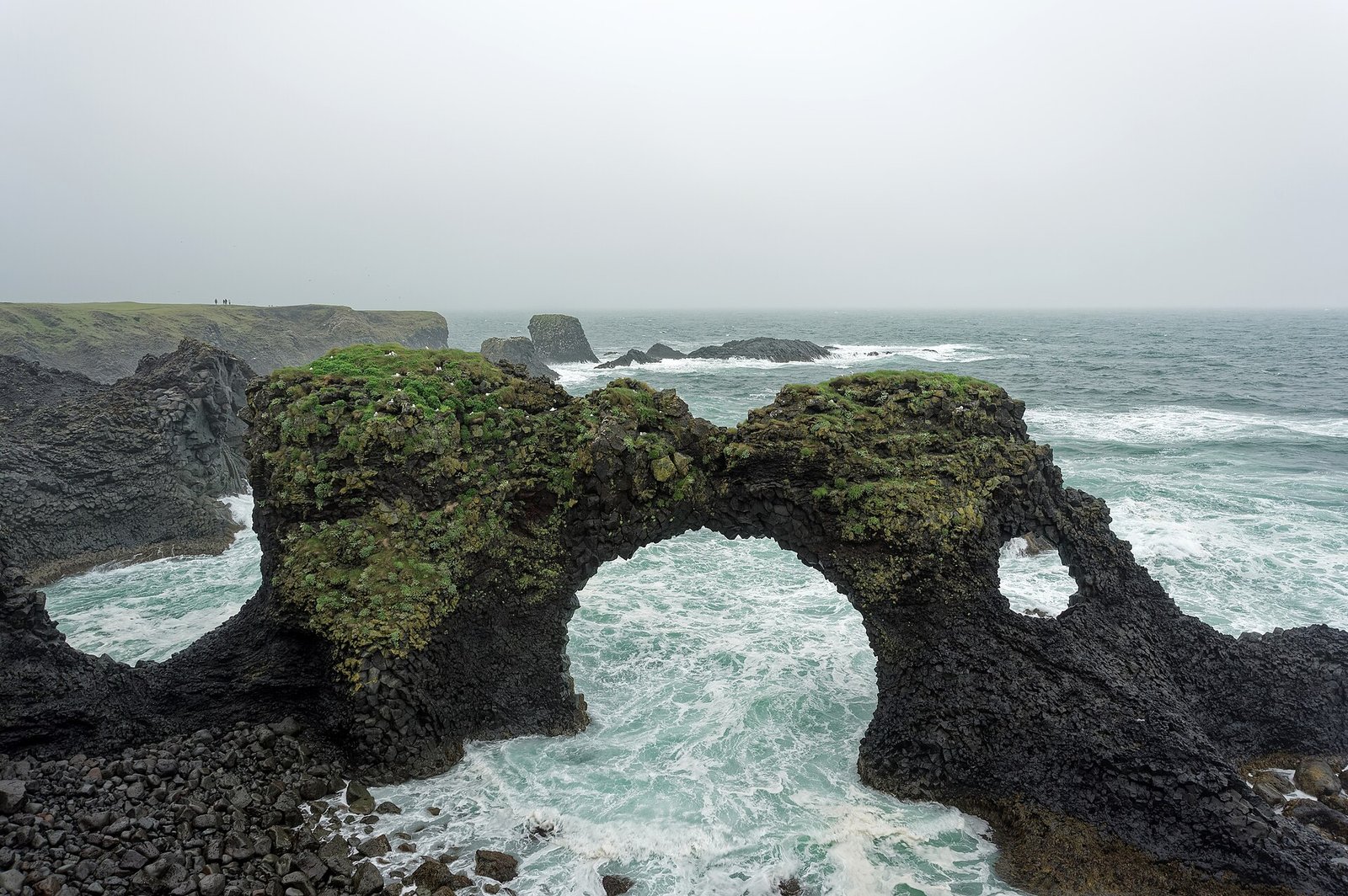
Arnarstapi is a tiny harbour village on the south coast, and the first of the Snæfellsnes fishing villages you’ll reach on the loop. The coast here is basalt that the sea has carved into arches, columns and caves. The famous one is Gatklettur, a stone arch you can see from the path a few minutes from the car park.
Above the car park stands a big stone figure of Bárður Snæfellsás. In the sagas, Bárður was half man, half troll, and the guardian spirit of the glacier. Locals still half-joke that he looks after the place.
- Parking: free. Arnarstapi is outside the national park, so the park fee doesn’t apply. There are public toilets by the road into the village.
- Food: a few seasonal restaurants and a café. There’s no shop, so bring snacks.
2. Hellnar: The Walk and the Café
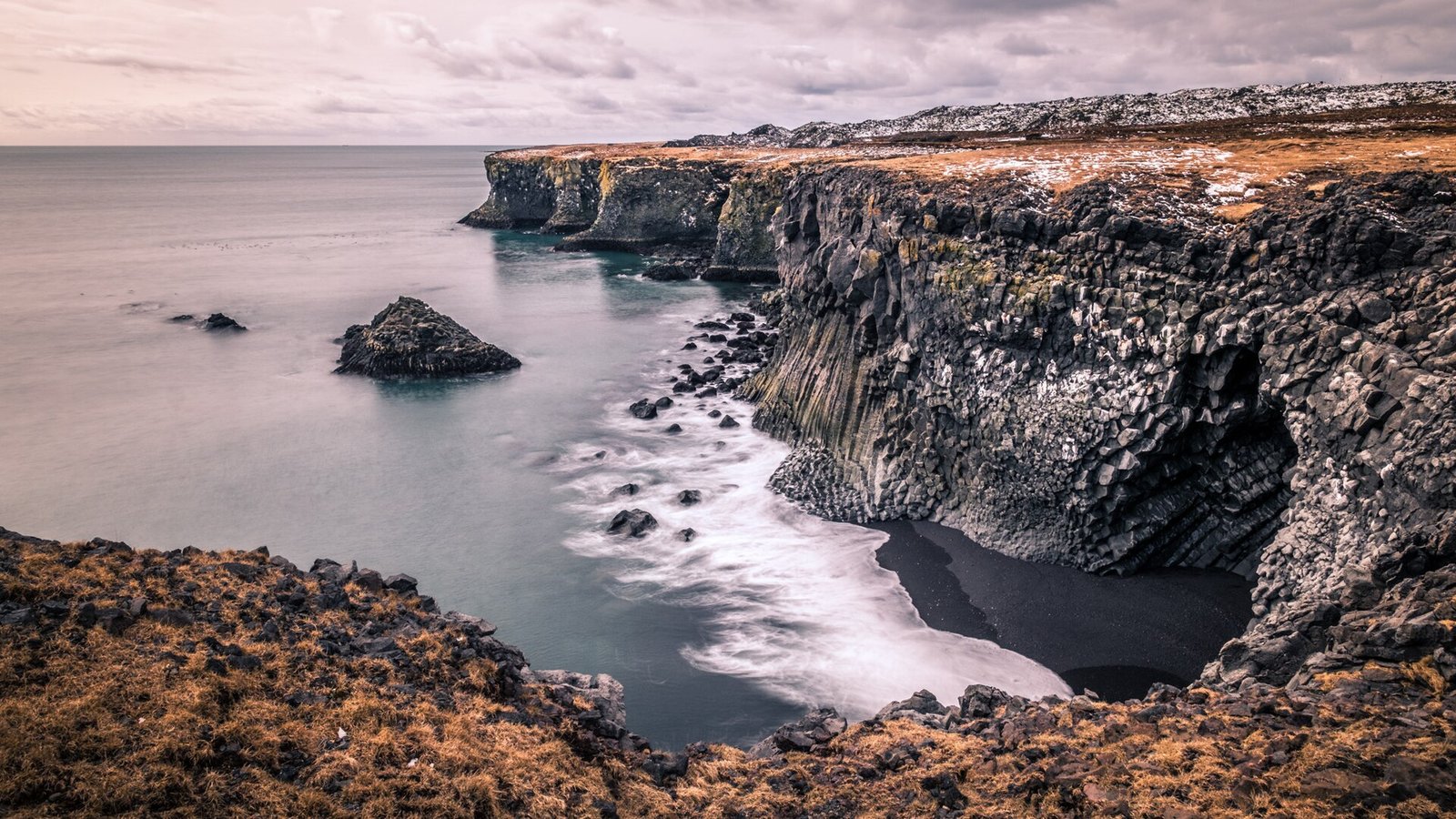
Hellnar is the smallest of the Snæfellsnes fishing villages on this list: a handful of houses, a little church and a café by the shore. The best way to arrive is on foot. The coastal path from Arnarstapi to Hellnar is about 2.5 km each way, roughly 45 minutes one way at an easy pace. It runs through a nature reserve, over the lava and along the cliff edge. There are no railings, so keep children close. In summer, Arctic terns nest along the path and will dive at your head. Wear a hat, and don’t take it personally.
At the Hellnar end, Fjöruhúsið is a tiny café right on the shore, best known for its fish soup. It’s seasonal: its listing gives 1 May to 15 November. It has no online menu, so I can’t give you a verified price. If you’re walking over for soup at the end of the day, don’t leave it too late. Hellnar is also only about 5 km by road from Arnarstapi, if someone would rather drive round and pick the walkers up.
Between Hellnar and Hellissandur you’re inside Snæfellsjökull National Park, which has its own big stops. The one I’d never skip is the black pebble beach with the lifting stones. I’ve written a separate post on Djúpalónssandur and how it compares with Reynisfjara, so I won’t repeat it here. Just remember the park service fee: 1,110 ISK per car, paid once and valid at every park car park until midnight (October 2026, snaefellsjokull.is).
3. Hellissandur and Rif: Murals and the Park Centre
Round the western tip, Hellissandur is the first of the Snæfellsnes fishing villages on the north coast. It’s small and quiet, but it has two good reasons to stop. The first is the murals: houses and walls around the village are painted with large outdoor artworks, and you can walk round them for free in half an hour or so. The second is the Snæfellsjökull National Park Centre, which has an exhibition about the park and the glacier, and toilets that are open 24 hours. Winter hours from 31 October 2026 are 10:00–16:30 on weekdays and 10:00–17:00 at weekends (snaefellsjokull.is).
Rif, a couple of kilometres east, is mostly a working harbour. If you like boats, drive down to the harbour and watch them come in. Otherwise, carry on to Ólafsvík.
4. Ólafsvík: The Real Working Town
If Arnarstapi is the postcard, Ólafsvík is the everyday Iceland, and the most hard-working of the Snæfellsnes fishing villages. It’s a fishing town with a proper harbour, a fish plant and a community that doesn’t really run on tourism. It isn’t “pretty” in the brochure sense. I like it for exactly that reason: you’ll see trucks of ice, nets on the quay, and people going to work.
The landmark is Ólafsvíkurkirkja, the church with the sharp, triangular spire and roof. You’ll spot it as you drive in. Ólafsvík is also the practical stop on the north coast: there’s a supermarket, fuel, and the municipal pool at 1,400 ISK for adults (2026 price list, snb.is). That’s one of the cheaper swims you’ll find in Iceland.

5. Grundarfjörður: Kirkjufell’s Town
Grundarfjörður is the most photographed of the Snæfellsnes fishing villages. It sits on a wide fjord with Kirkjufell, the arrowhead mountain from Game of Thrones, just west of the town. Kirkjufellsfoss, the small waterfall in front of it, is the photo everyone takes, and it’s worth it. Two things have changed, though:
- Parking at Kirkjufellsfoss costs money. It’s about 1,400 ISK for a small car, paid in the EasyPark app or at the machine (sannir.is). Pay the same day, or a late fee lands on your rental bill. It isn’t covered by the national park fee. Don’t park on the side of Road 54 to avoid it: it’s narrow and busy at the bridge.
- Don’t climb Kirkjufell. There’s no marked route, people have died on it, and the landowners have closed it before. Climbing is not allowed in winter. Admire it from below.
The town itself is small and friendly. It has an outdoor swimming pool with a view of the mountain, the Saga Centre with Kaffi Emil on the main street, and a busy harbour. Cruise ships stop here in summer, so Kirkjufellsfoss can be packed around midday. Early morning or evening is much quieter. One correction if you’re using an older list: Bjargarsteinn Mathús, long the best-known restaurant in town, closed in 2025 and the building is now accommodation.

What I’d book
A car for two days on Snæfellsnes
No regular bus links these villages. Compare local rental companies, and check how they charge the road fee.
6. Stykkishólmur: The Prettiest Harbour
Stykkishólmur is the biggest town on Snæfellsnes. If you only have time for one of the Snæfellsnes fishing villages, make it this one. The harbour is sheltered by the basalt island of Súgandisey, which is joined to the town by a causeway. Walk up to the little lighthouse at the top for the view over Breiðafjörður and its islands. It takes about 15 minutes and costs nothing.
- Norska húsið (the Norwegian House): built in 1832 from Norwegian timber. It was the first two-storey wooden home in Iceland, and it’s now the regional museum. Adults 1,800 ISK, under-18s free. Autumn 2026 hours are Tuesday–Friday 13:00–16:00 and Saturday 12:00–15:00 (norskahusid.is).
- Vatnasafn (Library of Water): an installation by the artist Roni Horn in the old library on the hill. It has 24 glass columns of water from Icelandic glaciers, and a great view. Open daily 11:00–17:00 in summer and 13:00–16:00 from September. Tickets are sold at the Norwegian House (stykkisholmur.is).
- The pool: 1,750 ISK for adults in 2026, according to the town’s price list.
- Eating: Sjávarpakkhúsið by the harbour opens every day from 18:00. Its menu has dishes from about 2,990 to 4,990 ISK, or a six-course tasting menu at 13,900 ISK per person (October 2026). That’s a treat, not a budget meal. For cheaper eating, see my food cost guide.
One correction for older guides: the Volcano Museum (Eldfjallasafn) closed some years ago, so don’t plan around it.


The Baldur ferry to the Westfjords
Stykkishólmur is also where the Baldur car ferry crosses Breiðafjörður to Brjánslækur in the Westfjords, stopping at Flatey island. The crossing takes about 2 h 10 min. In the 2026–27 winter season, a one-way ticket is 6,300 ISK per adult plus 6,300 ISK for a regular car up to 5 m, and campervans start at 9,180 ISK (ferja.is). Check the schedule before you plan around it: in mid-November 2026, ferja.is says Baldur is temporarily not running, with no restart date given. It was also away for part of summer 2026.
What It Costs: A Day on the Snæfellsnes Fishing Villages Loop
- Parking: national park 1,110 ISK + Kirkjufellsfoss about 1,400 ISK, so about 2,500 ISK per car. The villages themselves are free.
- Road charge on a rental car: the rental company either bills 6.95 ISK per km for cars up to 3,500 kg, or a flat 1,390 ISK per started rental day plus any admin fee (island.is). For the 480 km loop, the per-km rate comes to about 3,340 ISK.
- A swim: 1,400 ISK in Ólafsvík or 1,750 ISK in Stykkishólmur.
- Museums: 1,800 ISK at the Norwegian House.
- Fuel: there are stations in Ólafsvík, Grundarfjörður and Stykkishólmur, so fill up before the south side. If the pumps confuse you, read how to pay for gas in Iceland first.
Doing the Snæfellsnes fishing villages over two days doesn’t add much except a bed, and it makes the whole trip far less rushed. On the way back to Reykjavík, Borgarnes is the natural food stop. The Settlement Centre there has one of the lamb soups I’d drive for. If you’re staying the night, camping isn’t allowed inside the national park. Use a campsite instead: here’s where to camp, and here’s where campervans can legally stop.
Planning South Iceland yourself? Don’t overpay on the way.
My free guide: 10 things tourists waste money on in Iceland, and what locals do instead. Prices checked October 2026.
Snæfellsnes Fishing Villages FAQ
Which Snæfellsnes fishing village is best if I only have time for one?
Stykkishólmur, for the harbour, Súgandisey and the museums. If you’re only doing the south side of the peninsula, pick Arnarstapi and walk to Hellnar.
Can you do the Snæfellsnes peninsula as a day trip from Reykjavík?
Yes, but the loop is about 480 km and 7.5 hours of driving before you stop anywhere. Two days, sleeping in Grundarfjörður or Stykkishólmur, is much more enjoyable.
Is parking free in the Snæfellsnes villages?
In the villages, yes. You pay inside Snæfellsjökull National Park (1,110 ISK per car per day) and at Kirkjufellsfoss (about 1,400 ISK for a small car).
Is the Volcano Museum in Stykkishólmur open?
No. Eldfjallasafn closed some years ago. The Norwegian House and the Library of Water are the museums to visit now.
Does the Baldur ferry run all year?
Normally yes, between Stykkishólmur and Brjánslækur via Flatey. But it has been out of service for periods in 2026, and in mid-November it was listed as temporarily not running, so check ferja.is before you plan around it.